

Slow flow vs vinyasa: which yoga class should you book?
Slow flow and vinyasa share many of the same poses at very different speeds. What each class feels like, who each one suits, and how to choose between them in Mirissa.
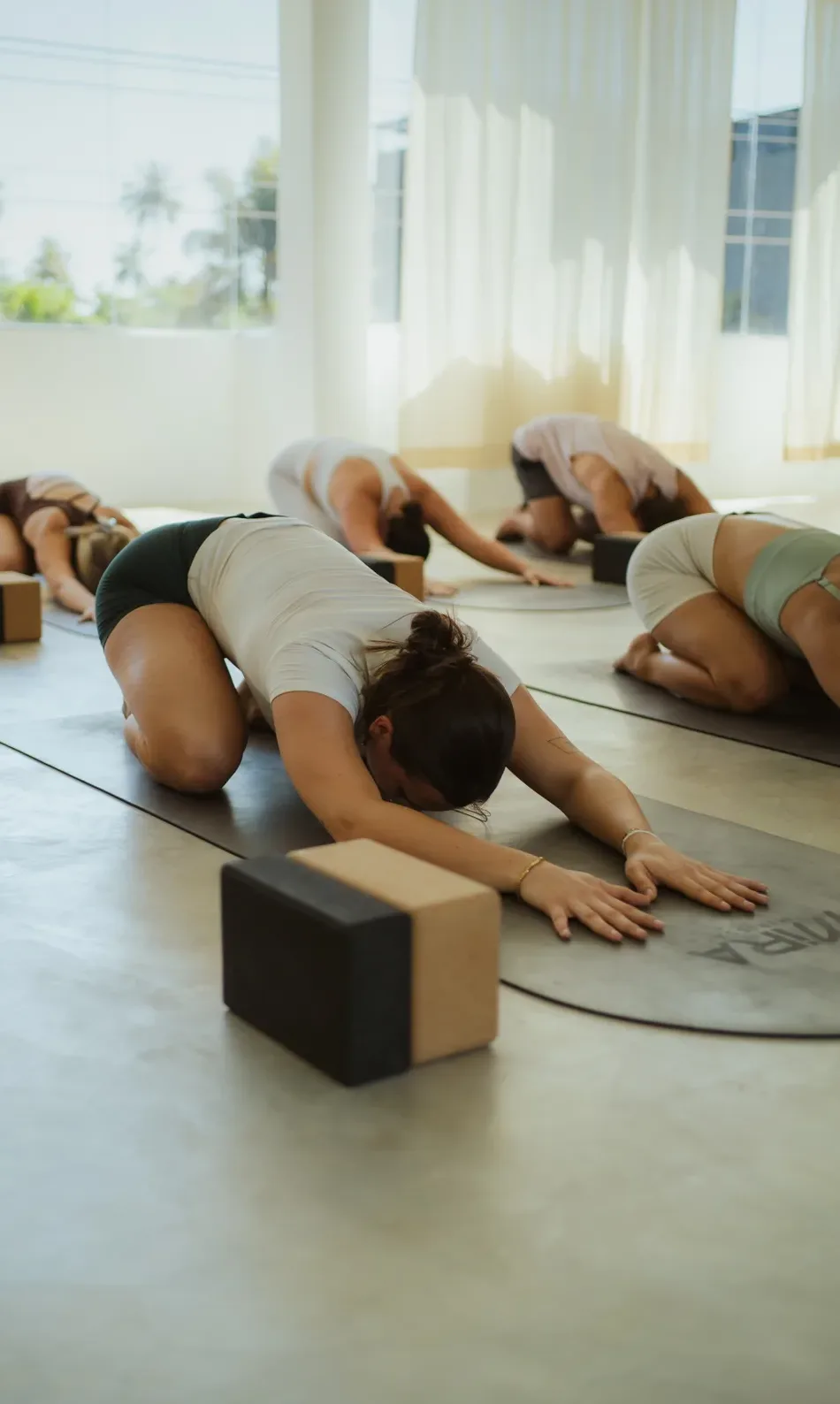
Two yoga classes on the same timetable can share half their poses and feel nothing alike. That is the situation with vinyasa and slow flow, the two styles we teach at MiRA, and it produces the question we hear most at the desk: which one should I book?
The short answer: book vinyasa if you want to move and sweat, and slow flow if you want to undo something. The longer answer is below.
What vinyasa is
Vinyasa links movement to breath. One inhale takes you into a pose, one exhale takes you out of it, and the class runs as a continuous sequence. You rarely stay anywhere for long: sun salutations, standing poses, a pass through plank and downward dog, and on to the next thing.
It builds heat, and most of the difficulty comes from pace and repetition. If you lose the thread, the class keeps going and you rejoin it at the next downward dog. People who like vinyasa usually like that momentum. It feels like exercise, because it is.
What slow flow is
Slow flow keeps the flow and takes away the hurry. There are noticeably fewer poses, often around half as many as a vinyasa class of the same length, and you stay in each one for several breaths. Four to eight is common. The transitions between poses are slow and deliberate rather than something to get through.
That changes more than the speed. You have time to hear an instruction and actually act on it. You have time to notice which side is tighter. And you have time to feel where a pose is working, which in a fast class is often over before you have found it.
Slow does not mean easy
This is the part people get wrong. Holding a lunge for eight breaths is harder on your legs than passing through it in one. There is no momentum to hide behind, and nowhere to go when it starts to burn.
What slow flow is lighter on is your heart rate. You are unlikely to finish out of breath. There are also usually fewer trips through plank and downward dog, which people with tired shoulders or sore wrists tend to appreciate.
So it is not the beginner version of vinyasa. It is a different kind of effort: less cardio, more control.
It is not yin, either
Slow flow is sometimes confused with yin or restorative yoga, and they are not the same thing. In yin, you are mostly on the floor, poses are held for minutes rather than breaths, and the aim is to relax the muscles completely. Restorative goes further and props you up with bolsters and blankets.
In slow flow you still stand, balance and move from one pose to the next. Your muscles are working the whole time. It sits between vinyasa and yin, which is why it suits so many people.
Who should book slow flow
- You have been surfing all week. Paddling tightens hips, shoulders and the upper back, and longer holds give them time to let go. More on that in yoga for surfers.
- You are new to yoga. The slower pace gives you time to understand each pose before the next one arrives. If you have never been to a class at all, read what to expect as a beginner first.
- You trained hard this morning. The day of a reformer class, or the day after a long travel day, a second fast class is rarely what your body is asking for.
- It is the evening. Slow flow winds you down. Vinyasa wakes you up. One of those is a better idea before bed.
- You always rush. If you have done vinyasa for years and move through every pose on autopilot, slowing down will show you what you have been skipping.
Who should book vinyasa
- You want a workout, and you want to sweat.
- You get restless holding still.
- You already know the basic poses and do not need them explained.
- It is the morning and you have energy to spend.
Can you do both?
Yes, and they work well as a pair: vinyasa on the days you have energy to spend, slow flow on the days you have already spent it. If you are in Mirissa for a week or more, alternating the two covers strength, mobility and recovery without needing anything else.
Slow flow at MiRA
Slow flow is our newest class. It runs for 60 minutes, three evenings a week, in the same air-conditioned studio as everything else. It is open to all levels and equipment is provided.
Vinyasa runs every day at 10am, with an earlier class at 7:15am on Mondays, Wednesdays and Fridays.
Both are $10 as a drop-in, and guests staying at MiRA get a discount on every class. You can usually walk in to yoga, though booking ahead is safer in peak season, December to April. The evenings change from time to time, so check the live schedule for this week’s slow flow classes.
If you still cannot decide
Book slow flow first. You will learn the poses at a speed where you can actually take in what the teacher is saying, and when you walk into a vinyasa class a day or two later, the sequence will make sense instead of rushing past you.