

Yoga for surfers: what a week in Mirissa does to your body
Paddling shoulders, tight hip flexors, a lower back that aches by day four. What surfing actually does to you, and the yoga that undoes it.
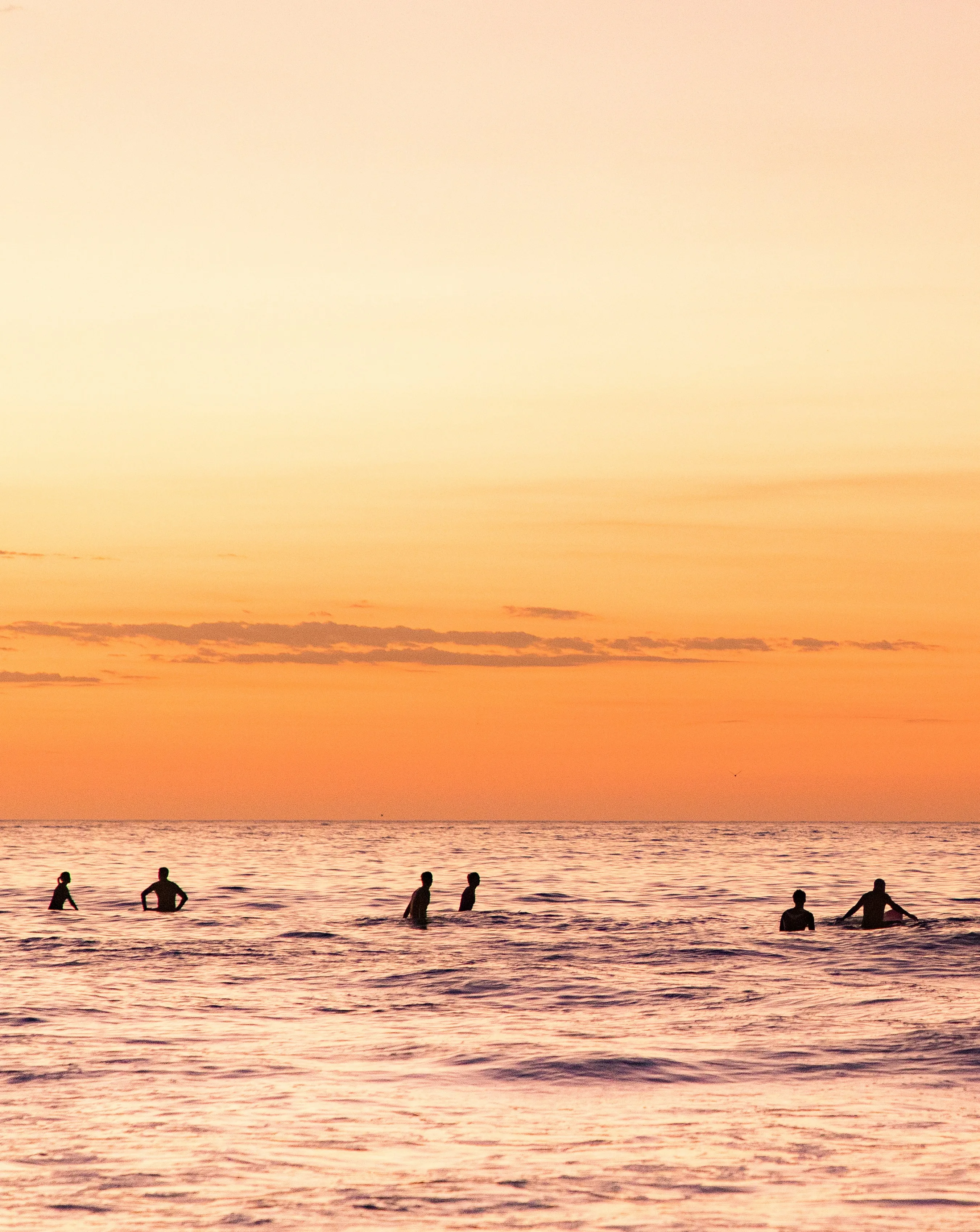
By day four of a surf trip, most people have the same three complaints. The shoulders burn on every paddle out. The lower back aches when standing still. And the hips feel like they belong to someone shorter.
None of that is bad luck. It is what surfing does to a body, and it is remarkably consistent from one person to the next. Which means it is also fixable — not with more stretching, but with the right kind of movement in the right order.
What surfing actually does to you
Most of a surf session is not surfing. It is lying face-down on a board, paddling. A two-hour session might be a hundred minutes prone and twenty seconds standing. Your body adapts to what you do most of.
Shoulders. Paddling is repetitive internal rotation under load, hundreds of reps per session. The muscles at the front of the shoulder and across the chest shorten and thicken. The small stabilisers at the back of the shoulder blade get overworked trying to hold the joint in place. This is why the ache sits deep and slightly behind the shoulder rather than where you expect it.
Hip flexors. Lying prone with your legs together holds the hip flexors in a shortened position for the whole session. Then you stand up and ask them to lengthen instantly. They resist, and the tension transfers upward.
Lower back. To keep your head above the water while paddling, you arch. That is sustained lumbar extension, held for most of the session, usually with the hip flexors already pulling the pelvis forward. The lower back ends up compressed from both directions.
One side more than the other. Every pop-up leads with the same foot. Every duck dive favours the same shoulder. A week of surfing builds a week of asymmetry.
Neck. Head up, eyes forward, for two hours. Nobody thinks about this one until it appears on day five.
What helps, and what does not
The instinct is to stretch whatever hurts. For surfers this is usually wrong, and occasionally counterproductive.
| What hurts | The usual fix | What actually helps |
|---|---|---|
| Shoulders | Pulling the arm across the chest | Opening the upper back, so the shoulder stops compensating for a stiff thoracic spine |
| Lower back | Twisting and folding to “release” it | Lengthening the hip flexors and waking the glutes, so the pelvis stops tipping forward |
| Hips | Deep passive stretching after a session | Active range work, so the muscles can control the length rather than just tolerate it |
| One-sided tightness | Stretching the tight side harder | Moving through rotation on both sides, evenly, so the imbalance stops compounding |
| Neck | Rolling it around | Getting the ribs and upper back moving, which is where the restriction usually starts |
The pattern is the same every time. The place that hurts is rarely the place that is stiff. Your shoulder aches because your upper back does not rotate. Your lower back aches because your hips do not extend. Chase the symptom and you get temporary relief; change the stiff joint and the symptom stops coming back.
There is a second reason not to stretch hard straight after a session. Muscle that has just worked for two hours is fatigued, not short. Loading it into a deep passive stretch while it is in that state puts the strain on the attachments rather than the muscle. That is how people end up with a nagging shoulder that never quite settles for the rest of the trip.
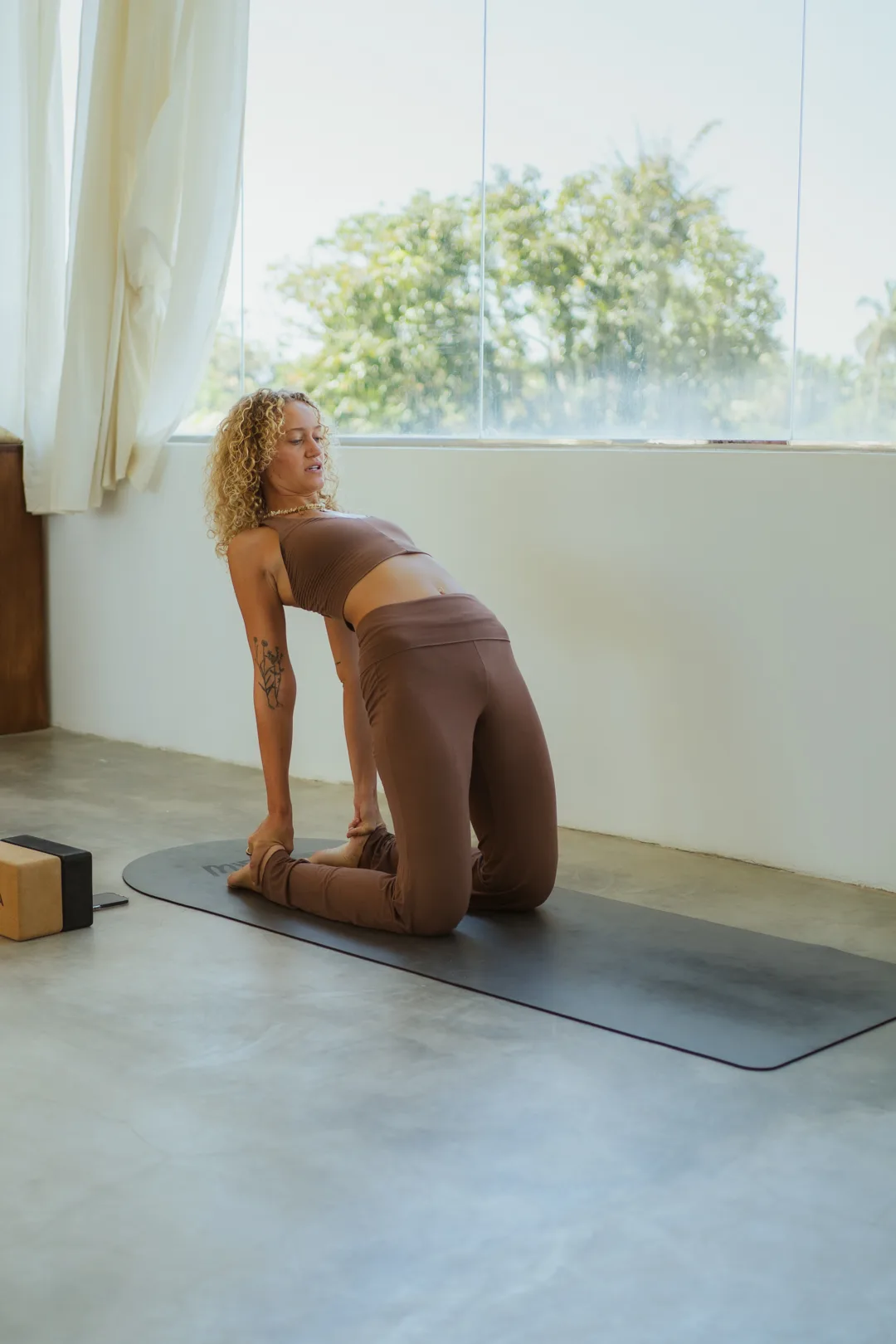
When to practise around surfing
Before a session you want to move, not stretch. Joint circles for the shoulders, some gentle rotation through the ribs, a few rounds of something that opens the front of the hips without holding anything for long. Five to ten minutes. The goal is to arrive in the water with everything already moving.
After a session is when a full class earns its place — but leave a gap. Eat something, drink something, let the nervous system come down from two hours of cold water and adrenaline. An hour later your body will take the work far better than it would straight off the beach.
On a rest day is when to do the real work. This is when deeper hip openers and sustained holds make sense, because you are not asking the same tissue to perform again in three hours.
Which class, and when
We run daily yoga in Mirissa at 10am, which lands neatly after a dawn session and before the wind comes up. It is Vinyasa — breath-led, building heat, with a long stretch and release phase at the end. For surfers that shape works well: you warm the tissue before you ask anything of it, and the deepest work happens when you are properly ready for it.
Two practical things worth knowing. The studio is air-conditioned, which matters more than it sounds when you have already been in the sun since six. And every class is mixed level with modifications offered throughout, so a first yoga class after a decade of surfing is not going to embarrass anyone.
If you are stiff enough that a flowing class sounds unappealing, say so before you start. Slowing down the transitions and holding the shapes longer turns the same class into something much gentler, and any instructor worth the name will offer it.
Four things you can do without a class
If you are not going to make it to a studio, these are the four that give the most back for the least time. Ten minutes, ideally on the days you surf.
Thread the needle. On all fours, slide one arm under the opposite side and let the upper back rotate. Ten slow rounds each side. This is the one that helps the shoulders most, despite not being a shoulder stretch.
Low lunge with the back knee down. Tuck the tailbone under before you lean forward — if you skip that part you are arching your lower back rather than opening the hip. Thirty seconds each side, breathing.
Glute bridges. Not a stretch. Twenty slow reps, squeezing at the top. Surfing switches the glutes off and the lower back picks up the work; this switches them back on.
Standing side bend, both sides evenly. Reach up and over, feel it along the ribs rather than the waist. This is the one that quietly fixes the neck.
The honest version
A week of surfing will make you stiff no matter what you do. The point of practising alongside it is not to feel loose — it is to keep the asymmetries from stacking up, so day seven feels like day two instead of like an injury waiting to happen.
Most people who come to a class mid-trip say the same thing afterwards: the next paddle out felt easier than any before it. That is not the stretching. It is the shoulders finally moving through their proper range because the upper back is participating again.
We are on the main road, four minutes from the beach, and you can drop in without booking if there is space. Ten dollars, mats and everything else provided, and nobody minds if you turn up with salt still in your hair.