

Your first yoga class: what actually happens
What vinyasa means, what to wear, whether you need to be flexible, and what nobody tells you about the first time you walk into a yoga studio.
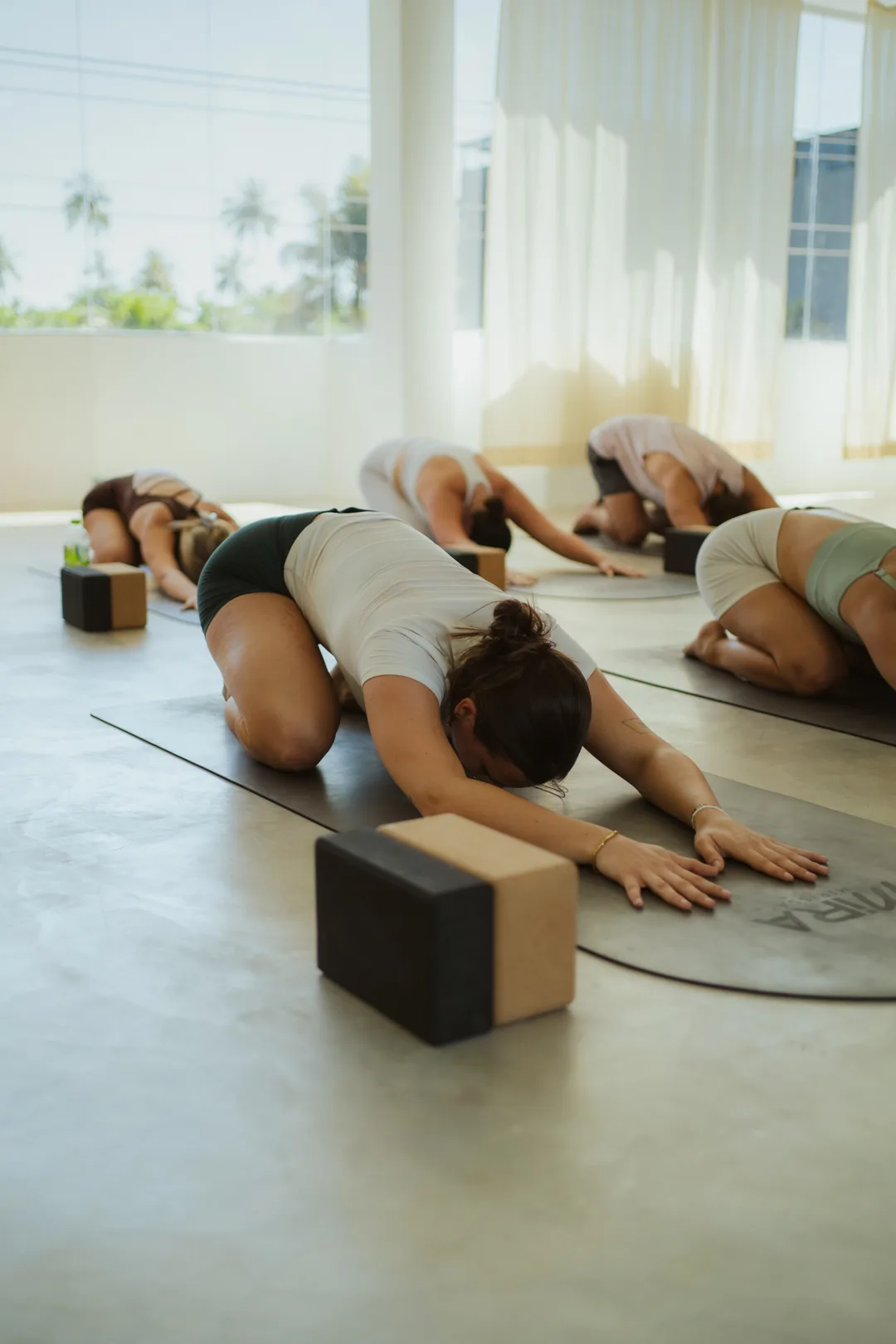
The most common reason people give for not trying yoga is that they are not flexible enough. This is a little like saying you are not fit enough to start exercising. Flexibility is a result, not a requirement.
Here is what a first class actually involves, so it is less of an unknown.
The styles you will encounter
Yoga is not one thing, and the word on the timetable tells you what kind of hour you are in for.
Vinyasa, the style we teach in our daily yoga classes in Mirissa, links movement to breath in a continuous flow. One pose leads into the next, usually with a breath cue for each transition. It moves, you will warm up quickly, and you will probably sweat. This is the style most people picture when they think of a modern yoga class.
Hatha is generally slower, holding poses for longer with pauses between them. Good for learning shapes properly.
Yin holds passive poses for several minutes at a time, working into connective tissue rather than muscle. It sounds restful. It is not always comfortable, though it is not strenuous.
Restorative uses props to support the body in positions held for a long time, with the aim of doing as little as possible.
If you are unsure, a slower class is the easier place to start, though plenty of people begin with vinyasa and get on fine.
Do you need to be flexible
No, and the belief that you do keeps a lot of people away.
Every pose has variations. A good instructor will offer them without making a production of it. Blocks exist to bring the floor closer to your hands. Straps exist to lengthen your arms. Bending your knees in a forward fold is not cheating, it is the correct version of that pose for most bodies.
The people in the room who look impressive have usually been doing this for years. That is the only difference.
What to wear and bring
Something you can move in that will not slide over your head when you fold forward. That is the whole requirement.
Yoga is done barefoot, so no shoes. Socks slip.
Bring water. In a tropical climate, bring more than you think.
If the studio provides mats, you do not need your own for a first class. Ours are provided.
What happens in the room
You arrive a few minutes early, leave your shoes outside, and find a space. Tell the instructor it is your first class. They will keep an eye on you and it costs nothing to say.
Classes usually open with a few minutes of sitting or lying still, some attention to breathing, and then a gradual warm-up. The pace builds, reaches a peak somewhere in the middle, and comes back down.
Almost every class ends with a few minutes lying flat on your back, called savasana. It feels strange the first time. Do not skip it and do not leave early, which is both the least restful thing you can do and disruptive to everyone else.
Things nobody warns you about
You will not know the Sanskrit names. Nobody expects you to, and the instructor will demonstrate.
You may be told to breathe in a specific way and find it awkward. That is normal and it settles.
You will probably look around at other people. Everyone does at first. It stops being interesting after a few classes.
You may find the last few minutes lying still are harder than the physical part. That is very common, and it is arguably the part with the most to offer.
Something may make a noise. Bodies do this. Nobody minds.
How often to go
More than once, before deciding whether you like it.
The first class is mostly spent working out where to put your limbs. The second is where you start noticing how it feels. If you can, go two or three times in your first week rather than once a week for three weeks.
Yoga and pilates together
People often ask which one to choose. They are not competitors.
Yoga tends to work on mobility, balance and the link between breath and movement. Reformer pilates works on controlled strength and precision. Doing both means the strength supports the mobility and the mobility makes the strength usable.
If you have time for both, do both.
With us
Yoga is $10, classes run about 60 minutes, and mats are provided. All levels are welcome and you can walk in, though booking online is safer in peak season from December to April.
Reformer pilates is $20 and must be pre-booked, as there are only 12 machines.
Guests get 20% off all classes, however they booked. Until 31 October 2026 that rises to 50%.