

Hot yoga, warm yoga, and air conditioning: what actually helps in the tropics
Sri Lanka is already 30 degrees. Does heated yoga make any sense here, is air conditioning cheating, and what does heat actually do to a practice?

People arrive in Sri Lanka and ask whether we do hot yoga. It is a reasonable question with a slightly strange answer, which is that a room in Mirissa in April is already hotter than most hot yoga studios in Europe, and nobody is heating anything.
That leaves a real question underneath. If you are practising somewhere that is thirty degrees and eighty percent humidity by default, does heat help you, and is cooling the room down missing the point?
What heat actually does
Warm tissue is more compliant. That much is true and measurable — muscle and connective tissue lengthen more easily when they are warmer, which is why every class on earth starts with a warm-up rather than a forward fold.
What heat does not do is any of the things it gets credited with. It does not detoxify anything; that is what your liver and kidneys are for. It does not burn meaningfully more calories. And the extra range you feel in a hot room is temporary — it is the tissue being briefly more pliable, not a lasting change in what your body can do.
That last point matters more than it sounds. In a hot room you will get deeper into a shape than you can normally control. Deeper than your muscles can hold you. The heat has given you range your nervous system has not agreed to yet, and range you cannot control is exactly where injuries happen.
This is not an argument against warmth. It is an argument for the difference between being warm and being cooked.
| Cool room | Warm room | Very hot room | |
|---|---|---|---|
| Tissue compliance | Needs a proper warm-up | Good after a few minutes | High immediately |
| What you feel | Stiff at first, settles | Comfortable throughout | Very open, very fast |
| Grip and balance | Reliable | Reliable | Slippery, balances get hard |
| Injury risk | Low if you warm up | Low | Higher — you can exceed your control |
| How you feel after | Clear | Clear | Wiped out, sometimes for hours |
| Fluid loss | Minimal | Moderate | Substantial |
The specific problem with heat in Sri Lanka
Hot yoga in a cold country is a controlled environment. The room is heated to a set temperature, humidity is managed, there is water, and the class is designed around the conditions.
Practising in an unshaded shala on the south coast at midday is none of those things. It is uncontrolled heat with uncontrolled humidity, in a class that was written for a temperate room, usually with nowhere to refill a bottle.
Humidity is the part people underestimate. Sweat cools you by evaporating; in eighty percent humidity it largely does not evaporate, so it stops cooling you and just runs off. You lose the fluid without getting the benefit. That is why an open-air class here at eleven in the morning is harder than a heated class at home, despite being cooler on paper.
The practical consequences show up in the same order every time. Grip goes first, so anything weight-bearing on the hands gets sketchy. Balance goes next. Then concentration, which is the one that actually ends the practice, because a class you cannot pay attention to is not doing much for you.
Is air conditioning cheating?
The objection goes something like this: you came to a tropical country, the heat is part of the experience, cooling the room is a hotel-gym version of yoga.
There is something to that, and if you want the full experience of practising in the climate you travelled to, an open shala at sunrise is genuinely one of the better things available on this coast. Do it.
But the argument falls apart as soon as you want to practise more than occasionally. The question is not whether heat is authentic. It is what conditions let you do the work you came to do.
At six in the morning, an open shala is perfect — cool, quiet, a breeze off the water. By ten it is a different room, and the practice you get is a survival practice rather than a deliberate one. Air conditioning is not there to make it easy. It is there so that ten in the morning is still a usable hour to practise in, and so that the second week of your trip has as many practices in it as the first.
There is a second, more boring benefit. A room with moving cool air has drastically fewer mosquitoes, because they cannot fly in it. Anyone who has tried to lie still through savasana in an open shala at dusk will understand why this matters.
What we actually do
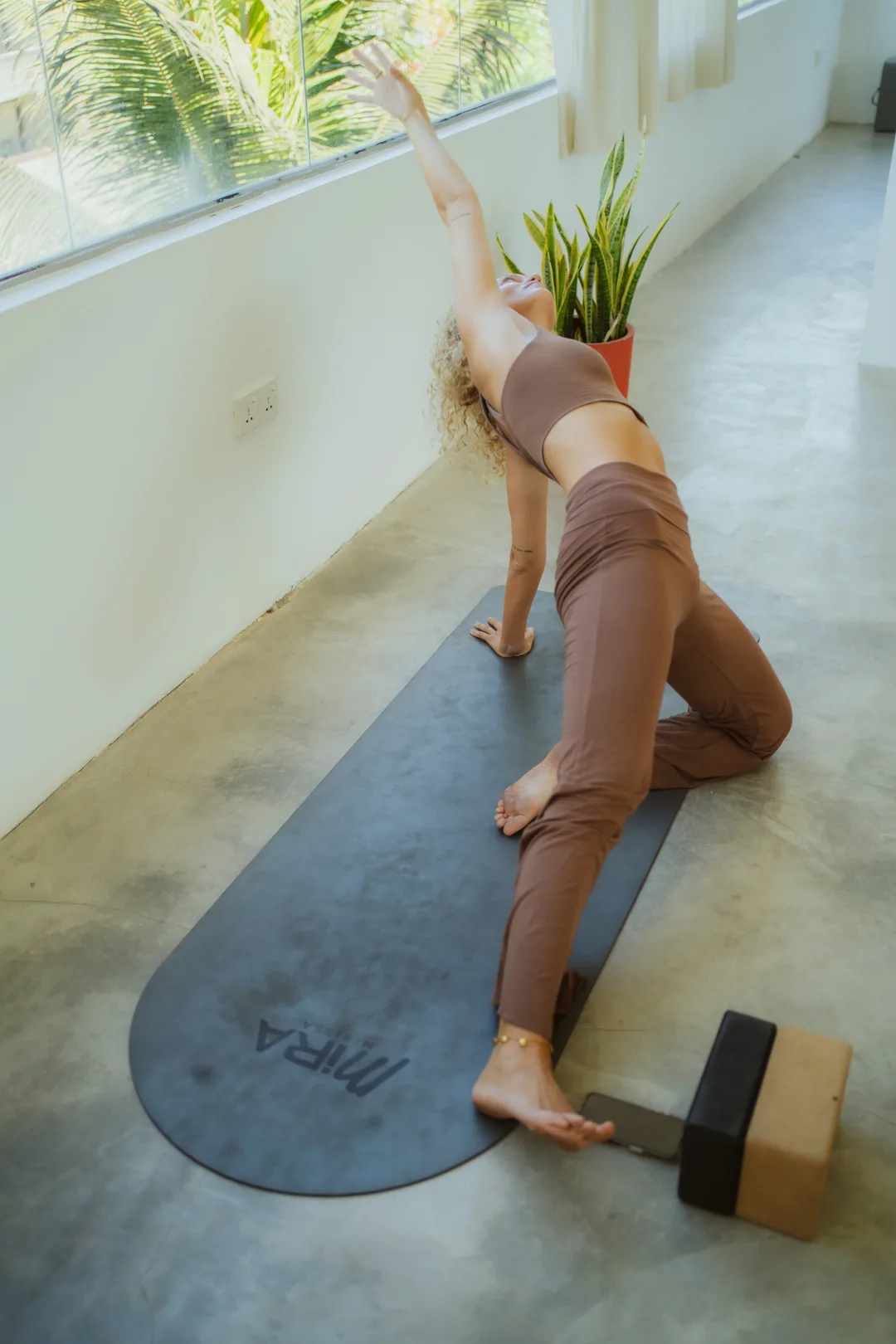
Our studio is enclosed with both air conditioning and ceiling fans, and we do not run hot yoga. The room sits at something comfortable rather than something extreme.
You will still sweat, and considerably more than you would in the same class in a temperate country — Sri Lanka is humid whatever the thermostat says, and a Vinyasa class builds its own heat regardless. What you will not do is spend the class managing the room instead of practising in it.
The reasoning is straightforward. We run daily classes at ten in the morning, which is the hour that suits most people’s day — after a surf, before work, before the heat peaks. Ten in the morning in an open room in Mirissa is not a practice, it is an endurance event. Cooling the room is what makes that time slot usable.
If you want the heat
Nothing above says avoid it. If you want to practise in the climate rather than away from it, here is how to do it without hurting yourself.
Go early or late. Before eight or after five. The middle of the day is not a matter of toughness, it is a matter of humidity.
Bring more water than you think. Most open shalas have none.
Do not chase the extra range. You will feel more open than you are. Take the shape you would take on a cool morning, not the one the heat offers you.
Take savasana seriously. Your body has done thermal work as well as physical work, and cutting the rest short is how you end up flattened for the rest of the afternoon.
Watch for the wrong kind of sweating. If you stop sweating, or go cold, or get a headache mid-class, that is not mental toughness territory. Sit down, get out of the sun, drink something.
The short version
Warmth helps a practice. Heat past a certain point stops helping and starts costing you — control, concentration, and occasionally a shoulder.
In a country that is already thirty degrees, the useful question is not how to get hotter. It is what conditions let you practise properly at the time of day you actually want to practise.
If that is sunrise in a garden, Mirissa has some beautiful options and you should use them. If it is ten in the morning after a surf, come and see us — it is $10, mats and props are provided, and the room will be a room rather than an opponent.