

What reformer pilates actually is, and why it is harder than it looks
The machine, the springs, what a first class involves, and how reformer differs from mat pilates and from yoga. Written for people who have never been on one.
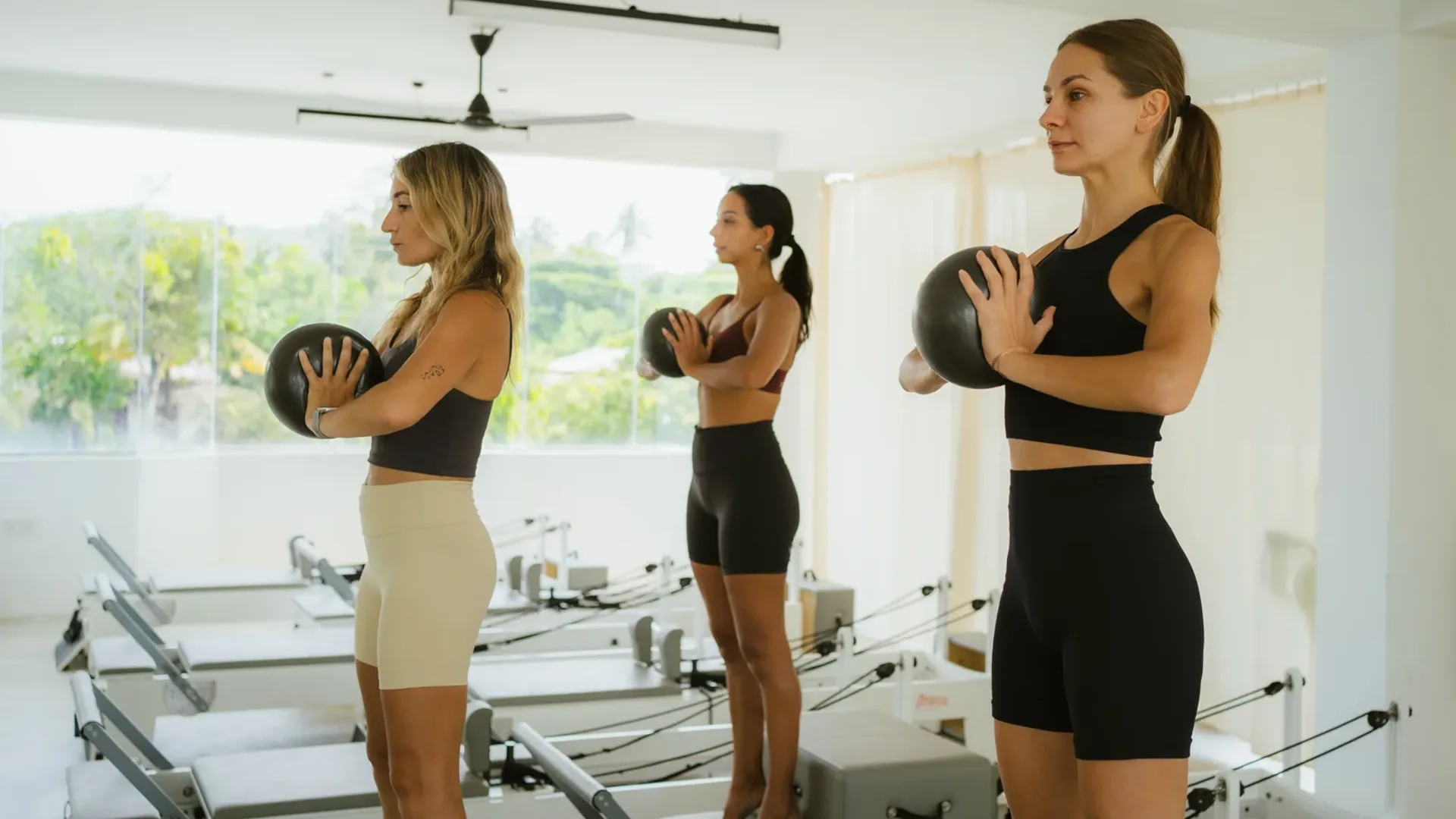
The first time most people see a reformer, they assume it is a piece of gym equipment that does the work for you. We run reformer Pilates in Mirissa every morning, and this is the question we field most. It looks like a bed with springs. It is not obvious what is difficult about lying down.
Then they do a class, and the next morning they cannot work out which muscle is complaining, because it is one they had not previously been introduced to.
The machine
A reformer is a flat carriage that slides along a frame on wheels. The carriage is attached to one end by springs, and there are straps and a footbar you push or pull against.
That is the whole apparatus. The cleverness is in what it does to resistance.
When you push the carriage away, the springs resist. When you let it come back, the springs are pulling, and you have to control the return. Most gym exercises let you relax on the way back. On a reformer, the return is often the harder half of the movement, because you are resisting something that wants to snap closed.
The springs can be adjusted, which is why the same machine works for a first-timer and for someone who has been doing it for years.
Why lighter springs are harder
This is the detail that surprises people, and it is worth understanding before your first class.
On most gym equipment, more weight means more difficulty. On a reformer it frequently runs the other way. Heavier springs give the carriage more stability and more assistance in certain exercises. Lighter springs mean you have to control the movement yourself, with nothing holding you steady.
So when an instructor takes a spring off, they are usually not being kind.
What it does that mat work does not
Mat pilates uses the same principles and your own bodyweight. It is genuinely effective and requires no equipment, which is its great advantage.
The reformer adds two things. It adds resistance you can dial up or down precisely, which means a movement can be made harder or easier without changing the movement itself. And it adds support, which sounds like the opposite but matters enormously: the carriage can hold part of your bodyweight, so someone who cannot yet do an exercise unassisted can do a supported version and build towards it.
That combination is why reformer work is used in rehabilitation settings as well as in fitness ones.
How it differs from yoga
If you have not tried either, our yoga classes in Mirissa are the gentler starting point.
People often ask which to do, as if choosing a side.
Yoga generally moves through poses linked to breath, holds positions, and works a good deal on flexibility, balance and mobility. There is strength work in it, but the strength is often a means rather than the target.
Reformer pilates is more directly about controlled strength, particularly through the trunk, and about precision of movement. You do fewer things, more slowly, with more attention to exactly how they are done. The breath matters but does not drive the sequence the way it does in a vinyasa class.
They complement each other well. Plenty of people do both in the same week and find each makes the other easier.
What a first class is like
You will be shown the machine before anything starts. Say it is your first time, because it changes what the instructor watches for.
Expect to be corrected on things that feel trivial. The position of your ribs, whether your shoulders are creeping up, whether your pelvis is level. These corrections are the actual content of the class. The movements themselves are simple; doing them precisely is not.
Expect it to be slower than you anticipated and harder than that slowness suggests.
Expect to shake. When a muscle is working at the edge of its control, it trembles. This is normal, it is not a sign you are doing it wrong, and it stops when you build up.
You will probably not be sweating the way you would after a run. You will still feel it for two days.
Practical points
Wear something reasonably close-fitting. Loose clothing makes it hard for the instructor to see your alignment, and can catch in the springs.
Grip socks are standard in most studios. Bare feet slip on the footbar.
Do not eat immediately beforehand. A lot of the work is through the middle of your body.
Tell the instructor about injuries, pregnancy, or anything recent. Reformer work adapts well to individual limitations, but only if the person running the class knows.
Booking with us
Our reformer classes are $20, run 50 minutes, and are capped at 12 people because we have 12 machines. They must be pre-booked, since there is no way to squeeze in an extra person once the machines are full.
Yoga and mat pilates you can walk into. Reformer you cannot.
Guests staying with us get 20% off all classes, however they booked. Until 31 October 2026 that rises to 50%.