

What a reformer class in Mirissa is actually like
A reformer class start to finish: what the machine does, what the instructor asks of you, what hurts the next day, and what to do if you have never touched one.
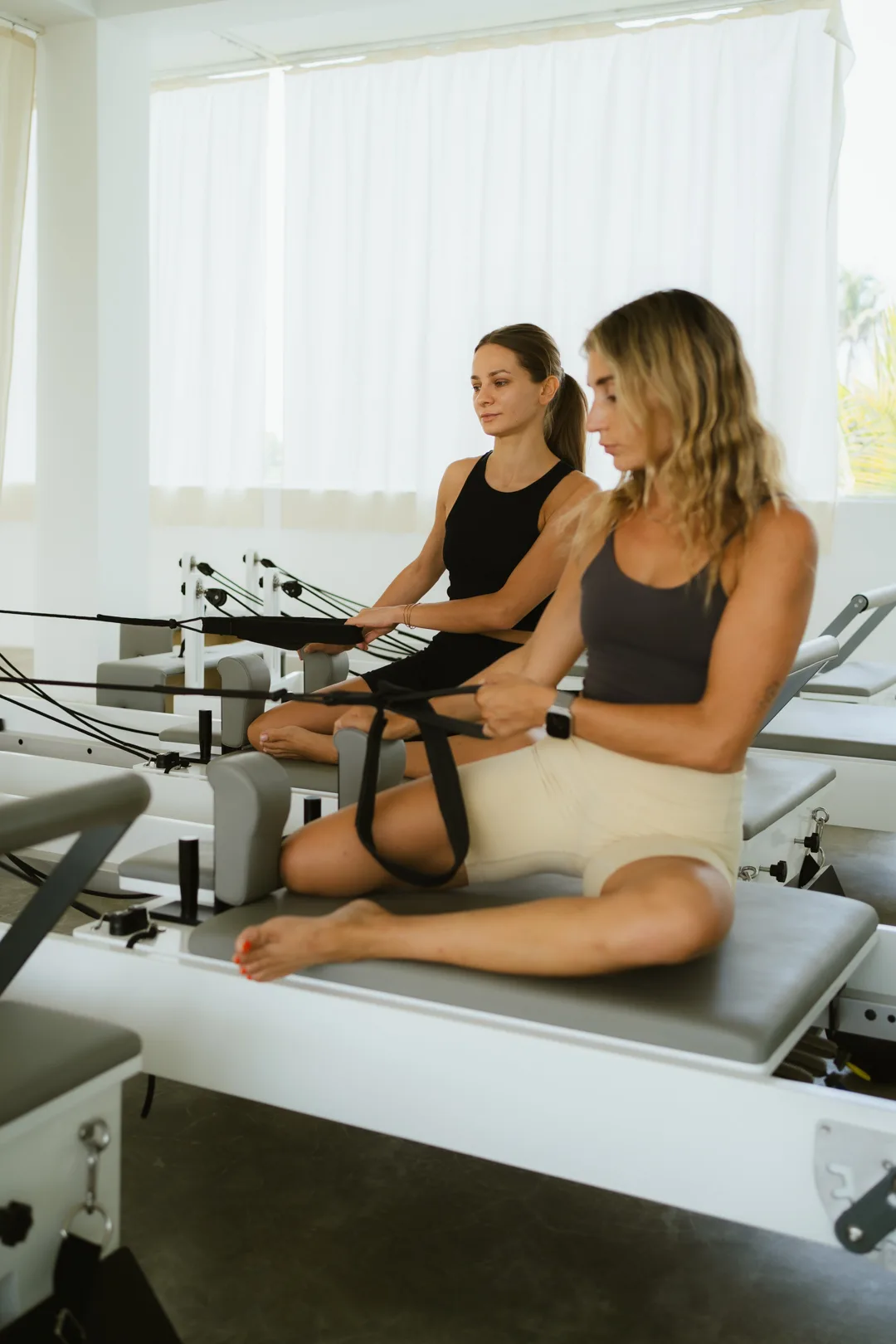
Most people who book their first reformer Pilates class here have been surfing for a week and can no longer lift their arms over their head comfortably. They arrive slightly wary of the machine, which looks like a rowing bench crossed with a medieval rack. This is what the next fifty minutes actually involve.
Before you get on
Class is at 8:30am, seven days a week. You book ahead, because there are twelve machines and no walk-in spaces. The studio is on the third floor, up stairs, and it is air conditioned, which is the single most important thing about it at that hour.
Wear something fitted enough that the instructor can see your hips and knees. Grip socks if you have them; there are spares if you don’t. Arrive ten minutes early for a first session, because setup takes a few minutes and doing it while eleven other people wait is nobody’s idea of a calm start.
You will be asked about injuries before anything else. Say the real answer, including the shoulder you have been ignoring since Weligama. On a reformer, the instructor can change the spring load around a problem rather than asking you to work around it, and that only happens if they know.
The first ten minutes look boring and are not
You start lying on your back, feet on the footbar, doing what looks like a slow leg press. This is footwork, and it is where you learn how the carriage responds: how much spring tension you are pushing against, how the carriage keeps moving if you stop controlling it, how much work your feet are doing versus your hips.
Everything later depends on that. The reformer’s springs do not just resist you. Depending on the exercise they also carry you, which is why the same machine is used in physiotherapy and by people who are already very strong. Joseph Pilates built the first version out of bed springs for patients who could not stand up.
The middle part is where it gets humbling
Once you are moving, the carriage slides, which means your body has to stabilise against movement rather than hold a shape. That is the difference from a mat, and it is why strong people are often surprised.
Expect footwork, then some combination of leg straps, arm straps, side-lying work and something involving kneeling on a moving platform while pulling a strap, which is when most people discover their obliques. Expect to be corrected often. A good instructor will adjust your ribs, your pelvis and the position of your head repeatedly, and that is the format working rather than you failing.
Expect it to be harder than it looks and less frightening than it looks, in that order.
What you will feel the next day
Usually the sides of your torso and the backs of your shoulders, which is precisely the chain surfing leaves underworked. Paddling is hours of internal shoulder rotation with the thoracic spine locked in extension. Reformer work targets the opposite pattern almost by default: rotation, scapular control, posterior shoulder, hip mobility.
Most people notice it in their paddling within a few sessions, usually before they understand why.
You are unlikely to be out of breath. If you want cardio, this is the wrong class, and some people find that anticlimactic. You will shake, though, and shaking is the point: the small stabilisers are being asked to do something they have been avoiding.
If you have never done any Pilates
Start with the reformer rather than the mat, which is the opposite of what most people assume. The machine gives you feedback, and feedback is what a beginner needs. On a mat you are guessing whether you are doing it right; on a reformer the carriage tells you immediately.
Classes here are mixed level, including complete beginners, and the instructor sets the spring load individually for each person in the room. Nobody will be watching you. Everyone is concentrating on not letting their own carriage slam.
The practical details
Fifty minutes, $20 or 6,000 rupees, daily at 8:30am, booked ahead. Class packs bring the per-class price down: four classes at $65.24, eight at $117.44, twelve at $156.59. Weekly is $50 for seven classes and monthly is $150 for thirty, which is the one that makes sense if you are in Mirissa for a month.
Guests staying with us get 20% off. Until 31 October 2026 that rises to 50%.
Afterwards, the rooftop ice bath runs 9:30 to 12:30 daily at $5, which is fifteen minutes after class ends and is not an accident. Cold immersion after resistance work reduces next-day soreness. One thing worth knowing: if your goal is building muscle, the evidence suggests cold straight after strength training may blunt some of the adaptation. If you are recovering between surf sessions, which is what nearly everyone here is doing, that trade-off does not apply.
If a machine class is not what you want, daily yoga is $10, vinyasa at 10am with an earlier 7:15am class on Mondays, Wednesdays and Fridays, and slow flow three evenings a week.
Who should skip it
If you have an acute injury rather than a stiff one, see a physiotherapist first. The reformer is used in rehab, but a group class is not rehab, and an instructor managing eleven other people cannot give you what a one-to-one assessment would.
And if you are after a sweaty, breathless hour, book the yoga instead. This is a different thing: precise, quiet, and surprisingly hard to fake your way through.