

Working remotely from Sri Lanka: the practical guide
Time zones, internet, power, visas and cost of living for anyone thinking about working from Sri Lanka's south coast. The parts the listings leave out.
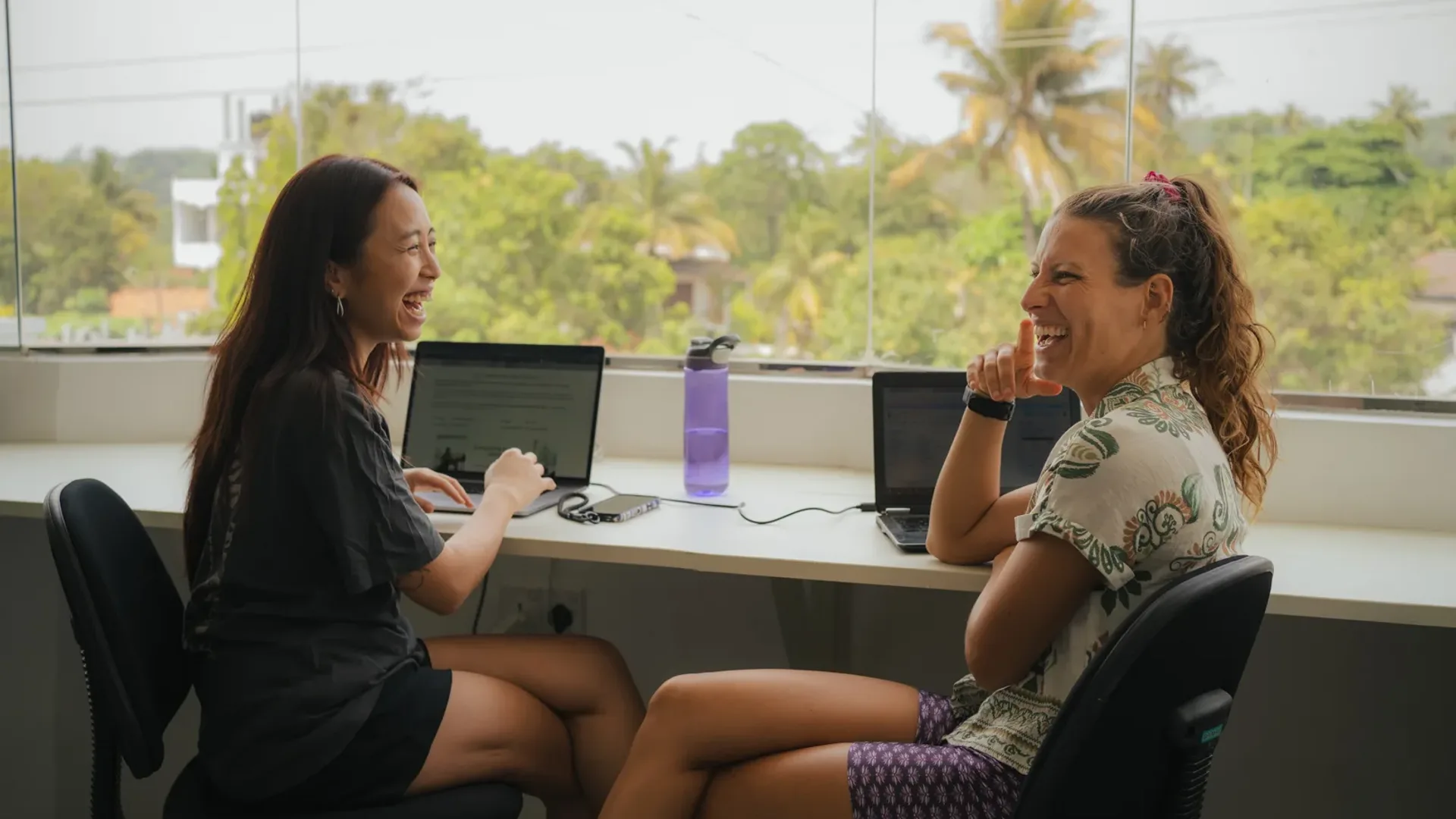
Sri Lanka gets written about as a beach destination and a surf destination. It gets written about far less as a place to work from, which is odd, because for a certain kind of remote job it lines up better than most of the region.
Here is what actually matters if you are considering it.
Start with the time zone
This decides whether the rest is worth reading.
Sri Lanka runs at UTC+5:30. That puts you four and a half hours ahead of London in winter and three and a half in summer, and around ten and a half hours ahead of New York.
If your team is in Europe, this is close to ideal. You get a long quiet morning to yourself and the overlap begins in your early afternoon. Most people find that uninterrupted early stretch is where their real work gets done.
If your team is on the US east coast it is harder but workable, since their morning is your evening. If they are on the west coast, you are looking at calls in the middle of your night. Think carefully before committing to that.
Australia and the Middle East sit comfortably.
Internet, honestly
This is where trips go wrong, so it is worth being blunt.
Mobile data is cheap and coverage on the south coast is good. Get a local SIM at the airport or in any town. For messaging and browsing it is more than enough, and it gives you a fallback.
Fixed-line internet is more variable. It works, and for most tasks it is fine, but it is not uniformly fast or uniformly stable. If your job involves long video calls or large transfers, do not assume the connection at a random guesthouse will carry you.
The failure pattern is always the same. Someone books somewhere beautiful, discovers the wifi cannot hold a call, and spends the trip working from cafes with worse chairs and the same problem.
Ask before you commit. Not “do you have wifi”, because everyone says yes, but what the connection actually is and whether there is a backup.
We run our coworking on Starlink, which is why. Satellite bypasses the local fixed-line infrastructure entirely, and that infrastructure is the part that tends to be the weak link.
Power
Sri Lanka has had scheduled power cuts in the past. The situation has been considerably more stable in recent years, but outages happen.
Practically: work somewhere with backup power if your job cannot absorb an unplanned hour offline, keep your laptop charged rather than running it down and topping up later, and carry a power bank.
Sockets are usually three round pins and the supply is 230V. Bring an adapter.
Visas
Sri Lanka does not currently have a dedicated digital nomad visa, so most remote workers come on a tourist visa and work for a foreign employer while here.
The rules and fees change, and they have changed repeatedly in recent years, which means any specific figure in a blog post is unreliable within months. Check the official immigration site before you book and again close to departure. If you are planning a long stay, look into extensions before you arrive rather than after.
What it costs
Sri Lanka is inexpensive by European or North American standards, though prices have risen and it is not the bargain it was a few years ago.
The two big variables are food and accommodation. Local food is very cheap. Western food in tourist areas is not, and the gap is wider than in most countries. Rice and curry from a local place against a beachfront brunch is a difference of several times over.
Long stays cost far less per night than short ones almost everywhere. If you are coming for a month, ask for a monthly rate rather than paying nightly.
Why the south coast
Mirissa sits on the south coast, roughly two and a half hours from Colombo airport by road.
It suits remote work for a few reasons. It is compact, so you are not losing an hour getting anywhere. There is enough of a foreign community that the services you need exist, without it feeling like a resort strip. And the daily rhythm fits: light comes early, mornings are cool enough to work in, and afternoons belong to the sea.
The monsoon runs roughly May to October here, bringing rough water and rain in bursts. That matters far less for working than for surfing. Some of the best months to be here with a laptop are the ones the beach crowd skips, because the town is quiet and everything costs less.
Setting yourself up
A few things that separate a good month from a frustrating one.
Get a local SIM on arrival. Cheap, quick, and it saves you when the wifi drops.
Work somewhere that is not your bed. The tropical version of working from your room is worse than the temperate one, because it is hot and you will end up horizontal.
Sort out air conditioning. Working through a Sri Lankan afternoon in still air is miserable and you will get less done.
Build your day around the heat rather than against it. Early mornings are the most productive hours here by a wide margin, and it is not close.
Working from us
Coworking is $8 for a full day, $42 for a week and $92 for a month. It runs on Starlink and is accessible 24/7.
Guests staying with us get 20% off coworking, however they booked. Until 31 October 2026 that rises to 50%. That applies whether you booked direct or through a platform.